


|
|||
|
|||
|
|
|
|
| Print Full report (203B) | < - Report Home : |
November 2005
Canberra
Commonwealth of Australia 2005
ISBN 0 642 78735 2 (printed version)
ISBN 642 78736 0 (HTML version)
Foreword
Membership of the Committee
Terms of reference
List of recommendations
In light of continuing community concern about and media attention to aviation security, on 25 May 2005 the Joint Committee of Public Accounts and Audit resolved to inquire into and report on developments in aviation security since its June 2004 Report 400: Review of Aviation Security in Australia. The Committee is continuing its review and expects to table its final report early next year.
On 7 June 2005 the then Deputy Prime Minister and Minister for Transport and Regional Services, the Hon John Anderson, announced a cabinet decision to conduct a review into airport security and policing to be conducted by the Rt Hon Sir John Wheeler DL.
On 21 September 2005, the Prime Minister and the Minster for Transport and Regional Services announced the Commonwealth Government’s in principle acceptance of the recommendations made by the Wheeler review and additional expenditure of $194 million to further tighten security at Australia’s major airports.
The Committee unanimously supports the recommendations of An Independent Review of Airport Security and Policing for the Government of Australia.
Based on the evidence gathered to date, the Committee has identified two areas of aviation security that are the subject of recommendations made by the Wheeler review, where further specific requirements should be put forward. These areas are:
The Committee has tabled this interim report in order to allow the Government to consider the following findings at the same time as it develops strategies to implement the Wheeler recommendations.
The Committee will make further recommendations across all areas of aviation security in its final report to be tabled in the new year.
Bob Baldwin MP
Chair
Chair |
Mr Bob Baldwin MP |
|
Deputy Chair |
Ms Sharon Grierson MP |
|
Members |
Senator John Hogg |
Hon. Bronwyn Bishop MP |
|
Senator Gary Humphries |
Mr Russell Broadbent MP |
|
Senator Claire Moore |
Ms Anna Burke MP |
|
Senator Andrew Murray |
Dr Craig Emerson MP |
|
Senator Fiona Nash |
The Hon Jackie Kelly MP |
|
Senator Nigel Scullion |
Ms Catherine King MP |
|
Senator John Watson |
Mr Andrew Laming MP |
|
|
Hon. Alex Somlyay MP |
|
|
Mr Lindsay Tanner MP |
|
|
Mr Ken Ticehurst MP |
Chair |
Mr Bob Baldwin MP |
|
Deputy Chair |
Ms Sharon Grierson MP |
|
Members |
Senator John Hogg |
Hon. Bronwyn Bishop MP |
|
Senator Claire Moore |
Mr Russell Broadbent MP |
|
Senator Fiona Nash |
Ms Anna Burke MP |
|
Senator John Watson |
Ms Catherine King MP |
|
|
Mr Andrew Laming MP |
|
|
Hon. Alex Somlyay MP |
|
|
Mr Ken Ticehurst MP |
Secretary |
Mr Russell Chafer |
Inquiry Secretary |
Dr Glenn Worthington |
Research Officers |
Ms Katie Ellis |
Administrative Officers |
Ms Penne Humphries |
The Joint Committee of Public Accounts and Audit will inquire into and report on developments in aviation security since its June 2004 Report 400: Review of Aviation Security in Australia , with particular reference to:
a) regulation of aviation security by the Commonwealth Department of Transport and Regional Services, and the Department’s response to aviation security incidents since June 2004;
b) compliance with Commonwealth security requirements by airport operators at major and regional airports;
c) compliance with Commonwealth security requirements by airlines;
d) the impact of overseas security requirements on Australian aviation security;
e) cost imposts of security upgrades, particularly for regional airports;
f) privacy implications of greater security measures;
g) opportunities to enhance security measures presented by current and emerging technologies, including measures to combat identity fraud; and
h) procedures for, and security of, baggage handling operations at international, domestic and regional airports, by both airlines and airports.
The Committee believes that every reasonable prec au tion should be taken in preventing the baggage of unwitting passengers being used for criminal purposes. One such measure would require that each item of checked baggage be individually weighed and the weight recorded on receipt by the airline.
The Committee is aware that the weight of a checked baggage item will vary between different sets of airport scales. However in the event that an allegation of baggage tampering is made, a reading of the baggage weight at the port of arrival can be transmitted to the port of origin. An equivalent weight could be placed upon the scales that recorded the original baggage weight to determine the degree of variation between the scales and to ascertain whether any weight increase or decrease has occurred.
While the recording of individual checked baggage items may not be able to detect small amounts of weight gain or loss, as would occur with the addition of small amounts of drugs, the Committee maintains that this measure would contribute to the peace of mind of the traveling public in Australia and possibly lessen their use of baggage wrapping services at airports, which can inhibit checked baggage screening processes – particularly the deployment of Explosive Trace Detection.
The covered rubbish receptacles at Adelaide International Airport provide opportunity for persons wishing to leave unaccompanied items in airports and stands in contrast to the open rubbish receptacles, that consisted of shallow-walled trays lined with sand, which the Committee observed during its inspection of Cairns International Airport .
However, the Committee is also concerned at the potential threat to security posed by the misuse and mismanagement of Visitor Identification Cards ( VICs ).
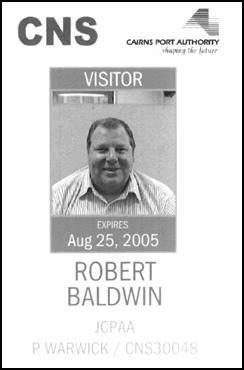
At Cairns International Airport , the Committee observed VICs were issued with photographic identification of the pass holder (see example over).
Photographic VICs are low cost items that provide two advantages over non-photographic VICs .
| Print Full report (203B) | < - Report Home : |


